

Lego-Style Timber Houses: ITB’s Modular Innovation Opens Massive Domestic Market for Indonesian Plywood
Lego-Style Timber Houses: ITB’s Modular Innovation Opens Massive Domestic Market for Indonesian Plywood
- 19 Jun 2026, 11:57
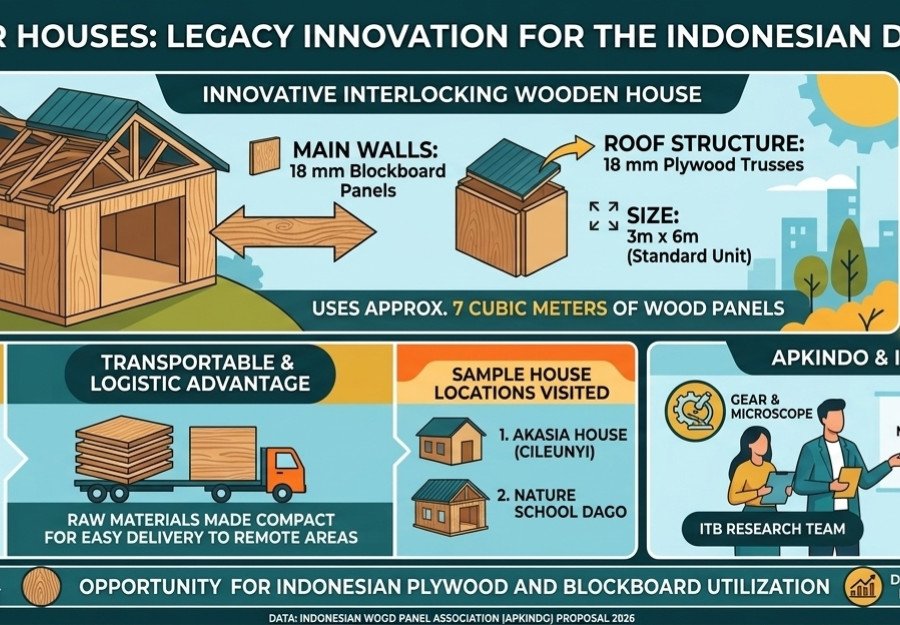
JAKARTA — The Indonesian Wood Panel Association (APKINDO) is moving swiftly to capture a burgeoning domestic market by exploring an innovative housing technology developed by the Institut Teknologi Bandung (ITB). This strategic initiative was realized through a working visit by APKINDO’s General Affairs and Research & Development (R&D) division to Bandung to deeply study and discuss the Modular Block House system. The adoption of this technology is seen as a crucial momentum for the association to drive the expansion and utilization of blockboard and plywood materials within the domestic market. The field visit serves as a direct follow-up to an initial discussion previously held at the APKINDO office with the ITB Modular Block Research Team. During that meeting, the ITB research team introduced a futuristic housing concept that relies on engineered wood products as its primary structural components. The walls of these modular houses are designed using 18 mm blockboard as the main material, while the roof trusses utilize the strength of 18 mm plywood. To build a single prototype unit with a standard size of 3 meters by 6 meters, the system consumes approximately 7 cubic meters of processed timber materials.
The primary appeal of this housing innovation lies in its construction system, which is engineered to be interlocking. This practical interlocking mechanism makes the assembly process incredibly easy and fast, closely resembling the activity of stacking children's Lego blocks. Beyond its ease of assembly, the raw components of these modular houses are designed to be highly compact. This compact specification provides a massive logistical advantage, making the structural components exceptionally easy to transport and deliver to remote, far-flung areas that lack access for heavy transport vehicles. Not only does it offer logistical efficiency and assembly convenience, but the flexible yet robust characteristics of timber also ensure that the Modular Block House structure boasts reliable earthquake-resistant capabilities.
To explore the potential of this technology further, the APKINDO delegation—led by the Secretary General alongside the Board of Directors for General Affairs and R&D—conducted a series of direct inspections in Bandung. The agenda commenced with an intensive discussion with the ITB Research Team at the ITB Directorate of Science and Technology Parks (DKST) located in the Summarecon area of Bandung. The meeting focused on gaining a comprehensive technical understanding of the system, discussing the guaranteed supply chain of raw materials from the local industry, and mapping out a formal cooperation program between APKINDO and ITB.
Following the discussion, the delegation immediately proceeded to the field to inspect two prototype locations featuring different architectural models and designs to observe the materials' real-world performance firsthand. The first site visited was the Akasia Prototype House located in Cileunyi. Afterward, the team moved to the second location to examine a different modular house design implemented at the Dago Nature School (Sekolah Alam Dago) in Bandung. Through these direct field observations, APKINDO remains highly optimistic that adopting wood-based modular technology will not only provide a practical and safe housing solution but also pave a wide path for the sustainable resurgence and absorption of national plywood products domestically. (geo_rob)