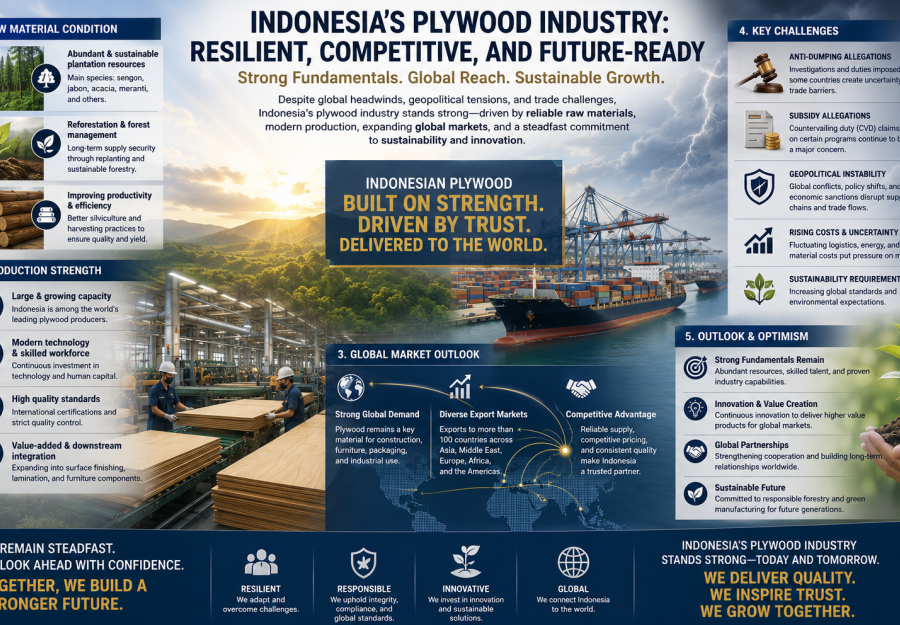
Indonesia’s Plywood Industry: Standing Firm Amid Global Turbulence, Navigating the Waves of International Trade
Indonesia’s Plywood Industry: Standing Firm Amid Global Turbulence, Navigating the Waves of International Trade
26 May 2026, 14:34
Despite mounting geopolitical tensions, rising production costs, and volatile export markets, Indonesia’s plywood industry continues to demonstrate resilience — while opening new opportunities across global markets.
JAKARTA — (26/5/2026) - APKINDONews - Indonesia’s plywood industry is currently facing one of its toughest periods in the past decade. National production during January–April 2026 reached 971,000 cubic meters, approximately 22% lower than the same period in 2025. Export value also declined sharply from US$441 million to US$324 million in the first quarter, while total annual production for 2026 is projected at only 2.8 million cubic meters — the lowest level in ten years. Yet behind the challenging numbers, early signs of recovery are beginning to emerge, and industry players remain confident that the sector’s fundamentals are still solid.
Cumulative natural forest log production during January–April 2026 reached 736,657 cubic meters, roughly 20% below 2025 levels. Kalimantan remains the primary supplier of meranti logs, while production in Sumatra fell by an average of 35% as several forest concession operations have yet to fully normalize.
Meranti log FOB prices remain relatively stagnant at elevated levels as industrial fuel costs in forestry operations continue to rise. Meanwhile, urea formaldehyde resin — a critical component in plywood manufacturing — has seen substantial price increases due to tightening industrial urea supply, some of which was reportedly exported to Australia in mid-May. Sengon logs, widely used for combi plywood and the domestic market, have remained relatively stable, fluctuating between Rp50,000 and Rp100,000 per cubic meter.
Average monthly plywood and LVL production in 2026 stood at approximately 217,000 cubic meters, significantly below the 2025 average of 279,000 cubic meters per month. All regions experienced declines: Sumatra (-35%), Kalimantan (-20%), Java-Bali (-22%), and Eastern Indonesia (-26%). Nevertheless, April 2026 production rebounded to 212,000 cubic meters following the March correction — a sign that the industry has not lost momentum.
One notable development is the resurgence of Film Face Plywood, driven by increasing European demand as buyers shift away from Chinese suppliers due to anti-dumping measures. Blockboard also remains a significant contributor, accounting for 22% of Indonesia’s total wood panel export composition.
Export volume during January–March 2026 totaled 670,000 cubic meters, down nearly 30% year-on-year. Asia remained the dominant destination with a 57% share, followed by North America (22%), the European Union (10%), and non-EU Europe (6%). Tanjung Perak served as the largest export gateway (47%), followed by Tanjung Emas (32%) and Tanjung Priok (15%). Product composition consisted of plywood (76%), blockboard (22%), and LVL (0.9%).
Amid the broader slowdown, the European Union emerged as the only export region recording significant growth, with export volume increasing 34% and value rising 21% year-on-year in Q1 2026. The United Kingdom also posted strong growth, with Indonesia’s wood panel exports rising 37.8% in volume and 45% in value, driven primarily by Film Face Plywood and Combi Plywood demand.
The United States market experienced the steepest decline. Indonesia’s plywood exports to the U.S. fell 62% in volume and 58% in value during Q1 2026 following the implementation of anti-dumping (AD) and countervailing duties (CVD). Final determinations are scheduled for July 15, 2026. Indonesia’s market position in the U.S. deteriorated sharply — from the top exporter in January to third place in February, and nearly absent from the market by March 2026.
However, Canada and Mexico have become important stabilizers for North America. Exports to Canada rose 62% in volume and 48% in value year-on-year in March 2026. Mexico recorded even stronger growth, with export volume surging 125% and value soaring 140%, making it one of Indonesia’s fastest-growing plywood markets.
Japan remains the most stable and favorable market for Indonesian producers. Average Japanese imports of Indonesian plywood reached 60,000–61,000 cubic meters per month during January–March 2026, up from 57,425 cubic meters monthly in 2025. More importantly, Japan has become one of the few markets accepting price adjustments, with several Indonesian producers successfully negotiating higher selling prices for upcoming shipments.
Japan’s housing starts in March 2026 stood at approximately 63,500 units, returning to normal monthly levels after unusually high figures in March 2025. The market has stabilized, while plywood inventories in Japan remain sufficient without significant supply shortages.
South Korea imported 1.95 million cubic meters of plywood during January–November 2025, up from 1.62 million cubic meters in 2024. Demand in 2026 continues to strengthen, particularly for floor-base plywood and 10mm renovation products. Indonesian exporters even succeeded in raising prices to South Korea by US$60 per cubic meter in April 2026.
Taiwan imported 867,000 cubic meters of plywood throughout 2025, although Indonesia continues to face pricing pressure there. Average Indonesian plywood prices to Taiwan were only US$210 per cubic meter — significantly below Vietnam (US$327) and Malaysia (US$491).
India’s market potential remains constrained by the slow implementation of BIS certification procedures, delaying broader market penetration. Malaysia imported 119,853 tons from Indonesia during January–March 2026, making it Indonesia’s third-largest market. Much of the material is used for laminates and secondary panel processing before being re-exported to third countries.
The impact of tensions around the Strait of Hormuz has been severe. Indonesia’s plywood exports to the Middle East during January–March 2026 plunged 52% in volume and 67% in value compared to the same period in 2025 — falling from US$39.1 million to only US$13 million. March 2026 marked the lowest point, with export volume collapsing 84% and export value dropping 91.4% year-on-year. Crude oil prices exceeding US$100 per barrel triggered surging freight costs and vessel shortages.
Still, industry players see substantial medium-term opportunities. If regional conflicts ease, reconstruction demand across the Middle East could create massive plywood consumption. Indonesia, with its large-scale production capacity and reputation as a reliable supplier, remains strategically positioned to capture that recovery momentum.
Although the European Commission cut eurozone growth forecasts from 1.3% in 2025 to 0.9% in 2026, Indonesia’s wood panel exports to the EU-28 surged, with volume rising 38% and value increasing 82% year-on-year in Q1 2026. Exports to the UK also climbed from US$5.2 million to US$7.5 million. For May–June 2026 shipments, Indonesian producers have already proposed price increases of US$40–100 per cubic meter to offset rising production costs.
On the regulatory front, the EU Deforestation Regulation (EUDR) will take effect on December 30, 2026, requiring Indonesian producers to strengthen geolocation systems and supply chain traceability. At the same time, the anticipated Indonesia–EU CEPA agreement, expected in 2027, could significantly reduce tariffs for HS 4412 products and strengthen Indonesia’s structural competitiveness in Europe’s premium market segment.
Indonesia’s economy expanded 5.61% year-on-year in Q1 2026, supported by Ramadan and Eid-related consumption, as well as government spending programs. The USD/IDR exchange rate approaching Rp18,000 has improved export competitiveness from a domestic cost perspective, although it simultaneously increases the cost of imported inputs such as chemicals and machinery spare parts.
Domestically, plywood selling prices have yet to fully adjust to rising production costs, leaving producers with increasingly thin margins. Major government projects, including the new capital city development (IKN), continue to apply procurement prices that many producers consider economically unsustainable. New cooperative programs are beginning to generate fresh demand, although their impact on national plywood consumption remains limited.
Indonesia’s plywood industry is now navigating a highly critical transition phase. Pressure is coming from multiple fronts: raw material supply has declined 20–35% across regions, production has contracted by 22%, exports to the U.S. have collapsed by 62% due to AD/CVD tariffs, and Middle Eastern exports have fallen 52% amid geopolitical instability. Production costs continue to rise alongside higher fuel prices, meranti log costs, and chemical prices.
Yet meaningful opportunities are also emerging. Europe has recorded export value growth of up to 82%, Canada 48%, Mexico 140%, South Korea has accepted price increases of US$60 per cubic meter, and Japan remains stable at 60,000–61,000 cubic meters per month. Film Face Plywood, a high value-added product, is steadily regaining market traction.
For international buyers, the message from Indonesia’s plywood industry is clear: we remain present, capable, and adaptive. With vast tropical forest resources, large-scale manufacturing capacity, and a proven export track record exceeding US$1.7 billion in 2025, Indonesia possesses the resilience needed not only to endure today’s challenges — but ultimately to grow stronger in the years ahead.(geo_rob)